What do you know about ?The New Zealand dollar

0 comments


The New Zealand dollar(The Kiwi)?


The New Zealand dollar, which is denoted by NZD or sometimes NZ$, is the official currency that used in New Zealand.The Kiwi is the informal term for this coinage that is derived from New Zealand's flightless bird called a kiwi. This national icon - The Kiwi bird - is pictured on one side of the country's $1 coin. So it is not uncommon to hear a news report say the kiwi is up, or down, in the day's trading.The NZD was announced in 1967 by the Government as a fractional coinage system in order to replace the New Zealand pound when the country decimalized its currency.Each New Zealand dollar or each Kiwi is divided into 100 cents. And it is also officially circulates in the Cook Islands, Niue, Tokelau and the Pitcairn Islands.By the end of July, 2006 the Reserve Bank of New Zealand introduced new coinage, removing the 5 cent coin from circulation, and replacing the 10, 20 and 50 cent coins with smaller ones.


Article Source :http://www.crownforex.com/en/Crown-tips.aspx?ID=18

What do you know about ?

0 comments
Wall Street
The Wall Street is a street in Manhattan (New York City). It was the first permanent address (Official Home) for the New York Stock Exchange. That's why they called it Wall Street Market. The phrase "Wall Street" is represent for all big business in the United States, whether based in New York City or not.The Wall Street is the historical heart of the largest U.S. brokerages and investment banks. Wall Street was named after the wooden wall Dutch colonists built in this area in 1653 to defend themselves from the British and Native Americans
Article Source :http://www.crownforex.com/en/Crown-tips.aspx?ID=13

House OKs $819B stimulus bill with GOP opposition

0 comments
In a swift victory for President Barack Obama, the Democratic-controlled House approved a historically huge $819 billion stimulus bill Wednesday night with spending increases and tax cuts at the heart of the young administration's plan to revive a badly ailing economy. The vote was 244-188, with Republicans unanimous in opposition despite Obama's frequent pleas for bipartisan support."This recovery plan will save or create more than three million new jobs over the next few years," the president said in a written statement released moments after the House voted. Still later, he welcomed congressional leaders of both parties to the White House for drinks as he continued to lobby for the legislation.Earlier, Obama declared, "We don't have a moment to spare" as congressional allies hastened to do his bidding in the face of the worst economic crisis since the Great Depression.The vote sent the bill to the Senate, where debate could begin as early as Monday on a companion measure already taking shape. Democratic leaders have pledged to have legislation ready for Obama's signature by mid-February.A mere eight days after Inauguration Day, Speaker Nancy Pelosi said the events heralded a new era. "The ship of state is difficult to turn," said the California Democrat. "But that is what we must do. That is what President Obama called us to do in his inaugural address."With unemployment at its highest level in a quarter-century, the banking industry wobbling despite the infusion of staggering sums of bailout money and states struggling with budget crises, Democrats said the legislation was desperately needed."Another week that we delay is another 100,000 or more people unemployed. I don't think we want that on our consciences," said Rep. David Obey, D-Wis., chairman of the House Appropriations Committee and one of the leading architects of the legislation.Republicans said the bill was short on tax cuts and contained too much spending, much of it wasteful, and would fall far short of administration's predictions of job creation.The party's leader, Rep. John Boehner of Ohio, said the measure "won't create many jobs, but it will create plenty of programs and projects through slow-moving government spending." A GOP alternative, comprised almost entirely of tax cuts, was defeated, 266-170.On the final vote, the legislation drew the support of all but 11 Democrats, while all Republicans opposed it.The White House-backed legislation includes an estimated $544 billion in federal spending and $275 billion in tax cuts for individuals and businesses. The totals remained in flux nearly until the final vote, due to official re-estimates and a last-minute addition of $3 billion for mass transit.Included is money for traditional job-creating programs such as highway construction and mass transit projects. But the measure tickets far more for unemployment benefits, health care and food stamp increases designed to aid victims of the worst economic downturn since the Great Depression of the 1930s.Tens of billions of additional dollars would go to the states, which confront the prospect of deep budget cuts of their own. That money marks an attempt to ease the recession's impact on schools and law enforcement. With funding for housing weatherization and other provisions, the bill also makes a down payment on Obama's campaign promise of creating jobs that can reduce the nation's dependence on foreign oil.The centerpiece tax cut calls for a $500 break for single workers and $1,000 for couples, including those who don't earn enough to owe federal income taxes.The House vote marked merely the first of several major milestones a for the legislation, which Democratic leaders have pledged to deliver to the White House for Obama's signature by mid-February.Already a more bipartisan — and costlier — measure is taking shape in the Senate, and Obama personally pledged to House and Senate Republicans in closed-door meetings on Tuesday that he is ready to accept modifications as the legislation advances.Rahm Emanuel, a former Illinois congressman who is Obama's chief of staff, invited nearly a dozen House Republicans to the White House late Tuesday for what one participant said was a soft sales job.This lawmaker quoted Emanuel as telling the group that polling shows roughly 80 percent support for the legislation, and that Republicans oppose it at their political peril. The lawmaker spoke on condition of anonymity, saying there was no agreement to speak publicly about the session. In fact, though, many Republicans in the House are virtually immune from Democratic challenges because of the makeup of their districts, and have more to fear from GOP primary challenges in 2010. As a result, they have relatively little political incentive to break with conservative orthodoxy and support hundreds of billions in new federal spending. Also, some Republican lawmakers have said in recent days they know they will have a second chance to support a bill when the final House-Senate compromise emerges in a few weeks. Rep. Randy Neugebauer, R-Texas, sought to strip out all the spending from the legislation before final passage, arguing that the entire cost of the bill would merely add to soaring federal deficits. "Where are we going to get the money," he asked, but his attempt failed overwhelmingly, 302-134. Obey had a ready retort. "They don't look like Herbert Hoover, I guess, but there are an awful lot of people in this chamber who think like Herbert Hoover," he said, referring to the president whose term is forever linked in history with the Great Depression.
Article Source :http://www.crownforex.com/en/articles.aspx?ID=1015

Bank of America gets big government bailout

0 comments
Bank of America Corp was rescued by the U.S. government on Friday through a $20 billion bailout and a guarantee for almost $100 billion of potential losses on toxic assets to cushion the blow from a deteriorating balance sheet at Merrill Lynch & Co, its recently acquired brokerage.The bailout makes Bank of America the biggest recipient of taxpayer money next to Citigroup as the government pours cash into the nation's banks to plug holes left by bad loans. The worst housing crisis since the Great Depression and the worst recession in many years have hammered U.S. banks.The capital is on top of $25 billion that Bank of America previously got from the Treasury Department's Troubled Asset Relief Program (TARP) in October and is the latest indication that authorities are still struggling to come to grips with the financial crisis that began about 18 months ago.In another bid to shore up banks in general, the government's Federal Deposit Insurance Corp. said it would propose lengthening the term on bank debt that it is prepared to guarantee to 10 years from three years. Banks must use the proceeds for new consumer lending.Both Citi and BofA, once the dominant U.S. banks, face mounting pressure from investors who question whether they have enough capital to cope with a tidal wave of bad debts.This crisis of confidence sent their shares plummeting on Thursday, with Bank of America's stock sinking as much as 28 percent to $7.35, its lowest in more than 17 years, and Citigroup's declining 26 percent to just $3.36. They both later recovered some of the losses, with BofA last quoted at $8.89 and Citi at $3.98.More details about their condition will surface early Friday, when the two banks report quarterly results. Citigroup is widely expected to report a huge loss, and some analysts also expect Bank of America to report a loss. Both brought forward their releases from next week.In return for the bailout, Bank of America, which just a few months ago was trumpeting the Merrill takeover as a coup, agreed to cut its dividend to 1 cent per share from 32 cents and cap executive pay -- concessions similar to those made by Citigroup when it was rescued in November.The dividend cannot be increased without government approval in the next three years.The guarantee also resembles the $306 billion backstop that Citigroup received. Bank of America will assume the first $10 billion loss on a pool of $118 billion of toxic assets, the U.S. government will take the next $10 billion, and the U.S. will assume 90 percent of all further losses, with BofA responsible for the remaining 10 percent. The assets are mainly mortgage-related assets inherited from Merrill.A U.S. official said President-elect Barack Obama's transition team had been notified of the Bank of America negotiations. Earlier, a financial policy source told Reuters that both President George W. Bush and Obama, who takes over on Tuesday, have signed off on the package of support.Bank of America sought the aid to absorb growing credit losses at Merrill, whose acquisition was completed on January 1, creating the largest U.S. bank.Bank of America is expected to post a quarterly profit of 19 cents per share, according to the average of analysts' expectations, but some analysts expect a loss.Citigroup, meanwhile, is expected to post a fifth straight multibillion-dollar quarterly loss, with analysts expecting a loss of $1.32 per share, excluding items.Citi is also expected to unveil a plan to significantly shrink its balance sheet and business model, a source has said. The bank, which has received $45 billion in TARP money, began that process on Tuesday with a deal to merge its Smith Barney brokerage with Morgan Stanley's wealth management unit."WARDS OF THE STATE"Analysts have raised the specter that both Bank of America and Citigroup could be nationalized at taxpayer expense."They both will likely become wards of the state," Doug Kass, who heads the hedge fund Seabreeze Partners Management, referring to Bank of America and Citigroup, said before the Bank of America bailout announcement. "They are too big to fail." Any effective government takeover would follow similar moves involving mortgage finance companies Fannie Mae and Freddie Mac and banks in Britain and Iceland. Ireland's government nationalized Anglo Irish Bank Corp Plc on Thursday. Citigroup denied speculation it might be nationalized, CNBC television reported. A bank spokesman declined to comment. Analysts said the government would like to avoid a repeat of the downfall of Lehman Brothers Holdings Inc, whose September 15 bankruptcy was viewed as a key trigger in a broad downturn in world economies and equities markets in the latter part of last year. Some positive news came Thursday from JPMorgan Chase & Co. The No. 2 U.S. bank reported a 76 percent decline in quarterly profit, but still topped some analysts' expectations. However, the bank boosted its estimate of potential losses from credit cards and from Washington Mutual Inc, which it took over last September. Moody's Investors Service lowered the bank's credit rating, saying "consecutive quarterly losses in the next 12-15 months cannot be ruled out." JPMorgan closed down $1.57, or 6.1 percent, at $24.34. The KBW Bank Index slid 8 percent, including a 26 percent drop at Marshall & Ilsley Corp. That Milwaukee bank said soured residential development loans, including in Arizona and Florida, led to a surprise quarterly loss. OVERREACHING? Bank of America's need for government help raised questions about whether CEO Kenneth Lewis overreached by buying Merrill for about $19.4 billion, and Countrywide Financial Corp, the largest U.S. mortgage lender, for $2.5 billion in July. The purchases extended Bank of America's tentacles throughout the financial system in a period of pronounced economic weakness. Bank of America had already halved its dividend in October as the capital concerns grew. "This looks, feels and smells like a redux of Lehman," said Tom Sowanick, chief investment officer of Clearbrook Financial LLC in Princeton, New Jersey, who was speaking before the formal bailout announcement. The Financial Times said Lewis sent lawyers to examine Merrill's books in December to determine if results worsened so materially that he could invoke a contractual right to scrap the merger. Meanwhile, Citigroup CEO Vikram Pandit is expected to shrink the bank by about one-third, after $20.3 billion of losses in the year ended September 30. But investors worry that any plan will dilute shareholder stakes, or not go far enough. "There is no faith in Bank of America and Citi," said Todd Leone, head of listed trading at Cowen & Co in New York. Lawmakers expressed concern about the industry's fragility. "They'll be back for more money" from TARP, said Sen. Bob Corker, a Tennessee Republican. "Our banking system is going to lose hundreds of billions of dollars," and taxpayer money is "going down the drain."
Article Source :http://www.crownforex.com/en/articles.aspx?ID=1008

Good bank, bad bank all adds up to nationalization

0 comments
Whether it's called good bank/bad bank, troubled asset relief or some new acronym, the United States appears to be on a course that will lead to the effective nationalization of some of the largest U.S. lenders.Investors have little confidence in the banks' ability to pull themselves out of the credit mess and are growing frustrated with a government response seen as haphazard. This is putting pressure on President Barack Obama to come up with a bolder plan.His economic team has dropped strong hints that an idea to buy up bad assets, which was proposed but then discarded under former President George W. Bush, may soon be resurrected.While the word "nationalization" is rarely uttered in official public discussion, the end result may be the same. By carving out the bad assets that are blocking the normal flow of credit and then pumping taxpayer money into the remaining healthy part, the public's stake in these institutions may exceed private holdings."It's really a question of semantics and what you call nationalization," said Kenneth Rogoff, a Harvard University professor and former chief economist of the International Monetary Fund. "The banking system can't stand on its own at the moment and it needs to be cleaned up and recapitalized."At issue is the same problem that has been plaguing financial firms and the economy for well over a year. Lax lending standards left banks with too many souring loans and insufficient capital to cover them.A series of government efforts to clean up the mess have fallen short, as evidenced by banks such as Citigroup and Bank of America coming back to government coffers for more money, in return for partial public ownership.Goldman Sachs economist Jan Hatzius has estimated that total credit losses may exceed $2 trillion globally, and banks have so far recognized less than half that much.STANDARD PLAYBOOKRogoff, whose academic research has focused on banking crises, said the current U.S. situation was no different from what countries such as Sweden experienced in the 1990s, and there is a "pretty standard playbook" for how to resolve it.In essence, the government takes over the troubled banks, separates the good and bad assets, and later resells the cleaned up bank to the private sector.Meanwhile, the bad assets sit in a publicly-funded "bad bank," and are eventually sold off, often at a substantial loss to taxpayers.Britain, in its latest attempt to tackle its own banking crisis, stopped short of hiving off bad assets. Instead it offered guarantees against future losses in the hopes that the banks would resume lending.The British government also intends to set up a 50-billion-pound fund to buy up high-quality securities like corporate bonds to try to get credit markets moving.But many economists thought that would be too little to solve the underlying problem of banks buried so deeply under bad debts that they cannot emerge.Until the bad assets are repriced, it makes little sense to pump more money into the banks, said Alex Pollock, a resident fellow at the American Enterprise Institute in Washington."Write down first and then recapitalize is the best that you can do," he said. "Japan learned the hard way what happens if you belatedly reprice and recapitalize."Scholars have dubbed the 1990s as Japan's "lost decade" because of policy-makers' halting approach to a financial crisis that strangled growth.NOT PRISTINEObama's administration is not keen to rush into any big decisions, but seems resigned to the fact that bold action will soon be required to stop the crisis from worsening."In a crisis of this magnitude, the most prudent course is the most forceful course," Treasury Secretary-designate Timothy Geithner said at his Senate confirmation hearing on Wednesday.He also said setting up a good bank/bad bank system is "enormously complicated to get right," stressing that any move in that direction would be cautious to avoid taking undue risks with public funds.For starters, said Wayne Abernathy, a financial policy expert with the American Bankers Association, it is tricky to develop and oversee an auction system for the assets, and there are quicker ways to get credit moving."How do you auction bundles of assets that are so different? You'd have to have a lot of little auctions if you want to go that route. It would be a management nightmare," he said.Another problem is distinguishing the good assets from the bad. Harvard's Rogoff said that as the credit crisis has moved well beyond its roots in the mortgage market, even garden variety consumer loans for things like cars or credit cards were defaulting at an increasing pace.The risk is that even after the government has tried to separate the good from the bad, there will be too many non-performing assets on the good bank balance sheet and no willing buyers will step up."The good bank/bad bank is not as pristine as it sounds when you're in the middle of a recession," Rogoff said.
Article Source
:http://www.crownforex.com/en/articles.aspx?ID=1011

descending triangles

0 comments

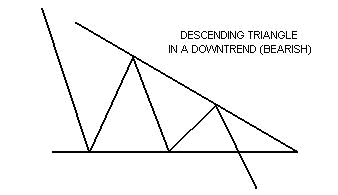
The descending triangle, also a variation of the symmetrical triangle, is generally considered to be bearish and is usually found in downtrends. Unlike the ascending triangle, this time the bottom part of the triangle appears flat. The top part of the triangle has a downward slant. Prices drop to a point where they are oversold. Tentative buying comes in at the lows, and prices perk up. The higher price however attracts more sellers and prices re-test the old lows. Buyers then once again tentatively re-enter the market. The better prices though, once again attract even more selling. Sellers are now in control and push through the old lows of this pattern, while the previous buyers rush to dump their positions. (And like the symmetrical triangle and the ascending triangle, volume tends to diminish during the formation of the pattern with an increase in volume on its resolve.) (Chart examples of descending triangle patterns using commodity charts.) (Stock charts.)
Futures and options trading carries significant risk and you can lose some, all or even more than your investment.
Stock trading involves high risks and you can lose a significant amount of money.
The information contained here was gathered from sources deemed reliable, however, no claim is made as to its accuracy or content. This does not contain specific recommendations to buy or sell at particular prices or times, nor should any of the examples presented be deemed as such. There is a risk of loss in trading futures and futures options and stocks and stocks options and you should carefully consider your financial position before making any trades. The reference to statistical probabilities does not pertain to profitability, but rather to the direction of the market. The size and the duration of the markets move, as well as entry and exit prices ultimately determines success or failure in a trade and is in no way represented in these statistics. This is not, nor is it intended to be, a complete study of chart patterns or technical analysis and should not be deemed as such.

symmetrical triangles

0 comments

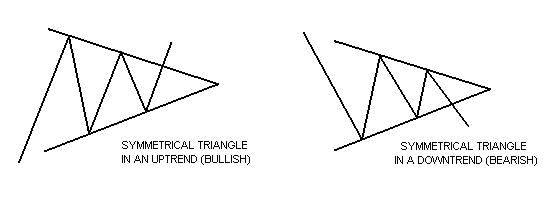
Symmetrical triangles can be characterized as areas of indecision. A market pauses and future direction is questioned. Typically, the forces of supply and demand at that moment are considered nearly equal. Attempts to push higher are quickly met by selling, while dips are seen as bargains. Each new lower top and higher bottom becomes more shallow than the last, taking on the shape of a sideways triangle. (It's interesting to note that there is a tendency for volume to diminish during this period.) Eventually, this indecision is met with resolve and usually explodes out of this formation (often on heavy volume.) Research has shown that symmetrical triangles overwhelmingly resolve themselves in the direction of the trend. With this in mind, symmetrical triangles in my opinion, are great patterns to use and should be traded as continuation patterns. (Chart examples of symmetrical triangle patterns using commodity charts.) (Stock charts.)
Futures and options trading carries significant risk and you can lose some, all or even more than your investment.
Stock trading involves high risks and you can lose a significant amount of money.
The information contained here was gathered from sources deemed reliable, however, no claim is made as to its accuracy or content. This does not contain specific recommendations to buy or sell at particular prices or times, nor should any of the examples presented be deemed as such. There is a risk of loss in trading futures and futures options and stocks and stocks options and you should carefully consider your financial position before making any trades. The reference to statistical probabilities does not pertain to profitability, but rather to the direction of the market. The size and the duration of the markets move, as well as entry and exit prices ultimately determines success or failure in a trade and is in no way represented in these statistics. This is not, nor is it intended to be, a complete study of chart patterns or technical analysis and should not be deemed as such.

ascending triangles

0 comments


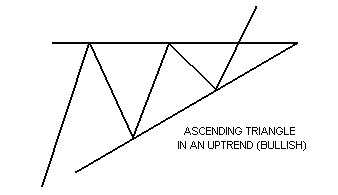
The ascending triangle is a variation of the symmetrical triangle. Ascending triangles are generally considered bullish and are most reliable when found in an uptrend. The top part of the triangle appears flat, while the bottom part of the triangle has an upward slant. In ascending triangles, the market becomes overbought and prices are turned back. Buying then re-enters the market and prices soon reach their old highs, where they are once again turned back. Buying then resurfaces, although at a higher level than before. Prices eventually break through the old highs and are propelled even higher as new buying comes in. (As in the case of the symmetrical triangle, the breakout is generally accompanied by a marked increase in volume.) (Chart examples of ascending triangle patterns using commodity charts.) (Stock charts.)
Futures and options trading carries significant risk and you can lose some, all or even more than your investment.
Stock trading involves high risks and you can lose a significant amount of money.
The information contained here was gathered from sources deemed reliable, however, no claim is made as to its accuracy or content. This does not contain specific recommendations to buy or sell at particular prices or times, nor should any of the examples presented be deemed as such. There is a risk of loss in trading futures and futures options and stocks and stocks options and you should carefully consider your financial position before making any trades. The reference to statistical probabilities does not pertain to profitability, but rather to the direction of the market. The size and the duration of the markets move, as well as entry and exit prices ultimately determines success or failure in a trade and is in no way represented in these statistics. This is not, nor is it intended to be, a complete study of chart patterns or technical analysis and should not be deemed as such.

What Does Average Directional Index - ADX Mean?

0 comments
An indicator used in technical analysis as an objective value for the strength of trend. ADX is non-directional so it will quantify a trend's strength regardless of whether it is up or down. ADX is usually plotted in a chart window along with two lines known as the DMI (Directional Movement Indicators). ADX is derived from the relationship of the DMI lines.
Article Source :http://www.investopedia.com/terms/a/adx.asp

Forex and Stock Market - Find the Difference

0 comments
We should remember that success of the workers in financial institutions depends on how many people they attract into the business of trading and how many transactions these clients make. They have direct financial interest therefore their opinions can be biased. Some of the widely known opinions are:In Forex traders burn out much quicker than in stock market.There are trading systems that allow anyone to become a millionaire quickly.Let's consider these opinions more closely. I couldn't find any reliable statistical data about participants in Forex and stock market that would have the following parameters.1. The number of traders who start trading. Percentage of traders who continue to trade after one, two and tree years. How successful their trading is.2. Relationship between beginning balance of their account and ending balance.3. Relationship between method of trading and success rate.There is no reliable statistics on these parameters. Only opinions and estimated guesses. The reason for the absence of such statistical data is understandable. It's a commercial secret. Nevertheless I can confidently say that there is no dramatic difference between trading Forex and trading stocks. There is no difference in opportunities to earn money as well to lose money in those markets. There is no or very little difference between them because in financial market you trade risks and probabilities not currencies, stocks and futures. The difference can be only in the rules of game, methods of execution of transactions, and liquidity of the market.Now let's talk about magical trading systems that allow you quickly and safely become a millionaire. They may say the system is a work of genius and sell it to your for some amount of money. Do you believe in it? It's true that you can't work in market without a system. Therefore any system has a right to exist. I don't believe in magical systems or universal machine that will make you money while you sleep.You can make money with any system if they are based on mathematics, psychology and discipline. It's not important what the system uses. It can use good old indicators like RSI or MACD. Or they may be built on some new indicators. You even can base your trading system on the number of blond women you meet on your way to office. But if you don't have a discipline to implement it consistently no system will help you.There are many more different opinions about Forex and stock market. The one common thing is that you can make money in any market. The only thing you need is to make well thought decisions and have a discipline to follow through with them.
Article Source :http://www.tradeforex2000.info/forexarticledirectory/Article/Forex-and-Stock-Market---Find-the-Difference/1166

Forex Trading Systems: The Key to Forex Profits

0 comments
While there are many different opinions between various Forex traders about which methods and strategies are best, there is one singular point that every Forex trader will agree on: you absolutely must have a great trading system to profit consistently. A great Forex trading system is the difference between profiting consistently from Forex trading and from finding yourself busted. There isn't a lot of middle ground, either. The right system will make you a lot of money. The wrong one will strip you of your entire investment.A great Forex trading system is one that first off will be successful at trading the market. If it doesn't make money, it's not any good. That part is obvious, but another part of that equation is how often the Forex trading system can actually be applied to the real and constantly moving currency market.Is it only when the market is trending? Counter-trending? Breakout? Is the system a combination of two of these, or some combination of all of these? How often the trading system can be used and how restricted the system is by market conditions. The market does not breakout often, but the best opportunities to get massive profits are during the breakout market. So a Forex trading system that is designed to be able to trade effectively no matter what state the market was in is obviously going to be far superior to any system that only trades with one market movement or in any other limited situation.Every successful Forex trader has a solid, tested, and proven Forex trading system. The same is true with any actual company that can consistently make money trading the Forex. This point can't be emphasized enough. Any company or individual trader that can consistently make money trading the Forex, and teach others how to do so as well, must be using a time proven Forex trading system. If you are only going to take one piece of advice from this article, then make sure it's this one: find a successful and time tested Forex trading system.Find a Forex trading system that has been used and tested for at least a couple of years, if not longer. The longer a company has been profiting from the Forex, and the longer that system has been tested, the better the chances of you coming out of trading the Forex grinning ear to ear about your new fortune.
Article Source:http://www.tradeforex2000.info/forexarticledirectory/Article/Forex-Trading-Systems--The-Key-to-Forex-Profits/1179

Bearish Centerline Crossover

0 comments
A Bearish Centerline Crossover occurs when MACD moves below zero and into negative territory. This is a clear indication that momentum has changed from positive to negative, or from bullish to bearish. The centerline crossover can act as an independent signal, or confirm a prior signal such as a moving average crossover or negative divergence. Once MACD crosses into negative territory, momentum, at least for the short term, has turned bearish.

The significance of the centerline crossover will depend on the previous movements of MACD as well. If MACD is positive for many weeks, begins to trend down, and then crosses into negative territory, it would be bearish. However, if MACD has been negative for a few months, breaks above zero, and then back below, it might be a correction. In order to judge the significance of a centerline crossover, traditional technical analysis can be applied to see if there has been a change in trend, higher High or lower Low.
The Unisys (UIS) chart depicts a Bearish Centerline Crossover that preceded a 25% drop in the stock that occurs just off the right edge of the chart. Although there was little time to act once this signal appeared, there were other warnings signs prior to the dramatic drop:
After the drop to trend line support, a Bearish Moving Average Crossover formed.
When the stock rebounded from the drop, MACD did not even break above the trigger line, indicating weak upside momentum.
The peak of the reaction rally was marked by a shooting star candlestick (blue arrow) and a gap down on increased volume (red arrows).
After the gap down, the blue trend line extending up from Apr, 1999, was broken.
In addition to the signals mentioned above, a Bearish Centerline Crossover occurred after MACD had been above zero for almost two months. From 20 Sept on, MACD had been weakening and momentum was slowing. The break below zero acted as the final straw of a long weakening process.
Article Source :http://stockcharts.org/help/doku.php?id=chart_school:technical_indicators:moving_average_conve

Bearish Moving Average Crossover

0 comments

The most common signal for MACD is the moving average crossover. A Bearish Moving Average Crossover occurs when MACD declines below its 9-day EMA. Not only are these signals the most common, but they also produce the most false signals. As such, moving average crossovers should be confirmed with other signals to avoid whipsaws and false readings.

Sometimes a stock can be in a strong uptrend, and MACD will remain above its trigger line for a sustained period of time. In this case, it is unlikely that a Negative Divergence will develop. A different signal is needed to identify a potential change in momentum. This was the case with Merck (MRK) in February and March. The stock advanced in a strong uptrend, and MACD remained above its 9-day EMA for 7 weeks. When a Bearish Moving Average Crossover occurred, it signaled that upside momentum was slowing. This slowing momentum should have served as an alert to monitor the technical situation for further clues of weakness. Weakness was soon confirmed when the stock broke its uptrend line and MACD continued its decline and moved below zero.

Negative Divergence

0 comments
A Negative Divergence forms when the security advances or moves sideways, and the MACD declines. The Negative Divergence in MACD can take the form of either a lower High or a straight decline. Negative Divergences are probably the least common of the three signals, but are usually the most reliable, and can warn of an impending peak.

The FedEx (FDX) chart shows a Negative Divergence when MACD formed a lower High in May, and the stock formed a higher High at the same time. This was a rather blatant Negative Divergence, and signaled that momentum was slowing. A few days later, the stock broke the uptrend line, and the MACD formed a lower Low.
There are two possible means of confirming a Negative Divergence. First, the indicator can form a lower Low. This is traditional peak-and-trough analysis applied to an indicator. With the lower High and subsequent lower Low, the uptrend for MACD has changed from bullish to bearish. Second, a Bearish Moving Average Crossover (which is explained below) can act to confirm a negative divergence. As long as MACD is trading above its 9-day EMA, or trigger line, it has not turned down and the lower High is difficult to confirm. When MACD breaks below its 9-day EMA, it signals that the short-term trend for the indicator is weakening, and a possible interim peak has formed.

Article Source :http://stockcharts.org/help/doku.php?id=chart_school:technical_indicators:moving_average_conve

Bullish Centerline Crossover

0 comments
A Bullish Centerline Crossover occurs when MACD moves above the zero line and into positive territory. This is a clear indication that momentum has changed from negative to positive, or from bearish to bullish. After a Positive Divergence and Bullish Centerline Crossover, the Bullish Centerline Crossover can act as a confirmation signal. Of the three signals, moving average crossover are probably the second most common signals.
Article Source :http://stockcharts.org/help/doku.php?id=chart_school:technical_indicators:moving_average_conve

Bullish Moving Average Crossover

0 comments
A Bullish Moving Average Crossover occurs when MACD moves above its 9-day EMA, or trigger line. Bullish Moving Average Crossovers are probably the most common signals and as such are the least reliable. If not used in conjunction with other technical analysis tools, these crossovers can lead to whipsaws and many false signals. Bullish Moving Average Crossovers are used occasionally to confirm a positive divergence. A positive divergence can be considered valid when a Bullish Moving Average Crossover occurs after the MACD Line makes its second "higher Low".
Sometimes it is prudent to apply a price filter to the Bullish Moving Average Crossover to ensure that it will hold. An example of a price filter would be to buy if MACD breaks above the 9-day EMA and remains above for three days. The buy signal would then commence at the end of the third day.
Article Source : http://stockcharts.org/help/doku.php?id=chart_school:technical_indicators:moving_average_conve

MACD Bullish Signals

0 comments
MACD generates bullish signals from three main sources:

Positive Divergence
Bullish Moving Average Crossover
Bullish Centerline Crossover
Positive Divergence


A Positive Divergence occurs when MACD begins to advance and the security is still in a downtrend and makes a lower reaction low. MACD can either form as a series of higher Lows or a second Low that is higher than the previous Low. Positive Divergences are probably the least common of the three signals, but are usually the most reliable, and lead to the biggest moves.
Article Source : http://stockcharts.org/help/doku.php?id=chart_school:technical_indicators:moving_average_conve

What Does MACD Do?

0 comments
MACD measures the difference between two Exponential Moving Averages (EMAs). A positive MACD indicates that the 12-day EMA is trading above the 26-day EMA. A negative MACD indicates that the 12-day EMA is trading below the 26-day EMA. If MACD is positive and rising, then the gap between the 12-day EMA and the 26-day EMA is widening. This indicates that the rate-of-change of the faster moving average is higher than the rate-of-change for the slower moving average. Positive momentum is increasing, indicating a bullish period for the price plot. If MACD is negative and declining further, then the negative gap between the faster moving average (blue) and the slower moving average (red) is expanding. Downward momentum is accelerating, indicating a bearish period of trading. MACD centerline crossovers occur when the faster moving average crosses the slower moving average.


This Merrill Lynch (MER) chart shows MACD as a solid black line, and its 9-day EMA as the thin blue line. Even though moving averages are lagging indicators, notice that MACD moves faster than the moving averages. In this example, MACD provided a few good trading signals as well:

In March and April, MACD turned down ahead of both moving averages, and formed a negative divergence ahead of the price peak.
In May and June, MACD began to strengthen and make higher Lows while both moving averages continued to make lower Lows.
Finally, MACD formed a positive divergence in October while both moving averages recorded new Lows.
Article Source :http://stockcharts.org/help/doku.php?id=chart_school:technical_indicators:moving_average_conve

MACD Formula

0 comments
The most popular formula for the "standard" MACD is the difference between a security's 26-day and 12-day Exponential Moving Averages (EMAs). This is the formula that is used in many popular technical analysis programs, including SharpCharts, and quoted in most technical analysis books on the subject. Appel and others have since tinkered with these original settings to come up with a MACD that is better suited for faster or slower securities. Using shorter moving averages will produce a quicker, more responsive indicator, while using longer moving averages will produce a slower indicator, less prone to whipsaws. For our purposes in this article, the traditional 12/26 MACD will be used for explanations. Later in the indicator series, we will address the use of different moving averages in calculating MACD.
Of the two moving averages that make up MACD, the 12-day EMA is the faster and the 26-day EMA is the slower. Closing prices are used to form the moving averages. Usually, a 9-day EMA of MACD is plotted along side to act as a trigger line. A bullish crossover occurs when MACD moves above its 9-day EMA, and a bearish crossover occurs when MACD moves below its 9-day EMA. The Merrill Lynch (MER) chart below shows the 12-day EMA (thin blue line) with the 26-day EMA (thin red line) overlaid the price plot. MACD appears in the box below as the thick black line and its 9-day EMA is the thin blue line. The histogram represents the difference between MACD and its 9-day EMA. The histogram is positive when MACD is above its 9-day EMA and negative when MACD is below its 9-day EMA.
Article Source :http://stockcharts.org/help/doku.php?id=chart_school:technical_indicators:moving_average_conve

Bollinger Bands Tutorial: Introduction

0 comments
Trading bands, which are lines plotted in and around the price structure to form an envelope, are the action of prices near the edges of the envelope that we are interested in. They are one of the most powerful concepts available to the technically based investor, but they do not, as is commonly believed, give absolute buy and sell signals based on price touching the bands. What they do is answer the perennial question of whether prices are high or low on a relative basis. Armed with this information, an intelligent investor can make buy and sell decisions by using indicators to confirm price action.
But before we begin, we need a definition of what we are dealing with. Trading bands are lines plotted in and around the price structure to form an "envelope." It is the action of prices near the edges of the envelope that we are particularly interested in. The earliest reference to trading bands I have come across in technical literature is in The Profit Magic of Stock Transaction Timing; author J.M. Hurst's approach involved the drawing of smoothed envelopes around price to aid in cycle identification.

Figure 1 shows an example of this technique: Note in particular the use of different envelopes for cycles of differing lengths.
The next major development in the idea of trading bands came in the mid to late 1970s, as the concept of shifting a moving average up and down by a certain number of points or a fixed percentage to obtain an envelope around price gained popularity, an approach that is still employed by many. A good example appears in Figure 2, where an envelope has been constructed around the Dow Jones Industrial Average (DJIA). The average used is a 21-day simple moving average. The bands are shifted up and down by 4%.
FIGURE 2:
The procedure to create such a chart is straightforward. First, calculate and plot the desired average. Then calculate the upper band by multiplying the average by 1 plus the chosen percent (1 + 0.04 = 1.04). Next, calculate the lower band by multiplying the average by the difference between 1 and the chosen percent (1 - 0.04 = 0.96). Finally, plot the two bands. For the DJIA, the two most popular averages are the 20- and 21-day averages and the most popular percentages are in the 3.5 to 4.0 range.
Article Source : http://www.bollingerbands.com/services/bb/

Why you should consider forex (Currency) trading as your primary business ?

0 comments
In forex trading, you decide when you want to work, how long you want to work, and how much money you want to make (You are the Boss)
Forex trading requires limited equity and the yield could be unlimited
You can make money anywhere (as long as you are connected to internet) and anytime (forex market opens 24 hours a day, 5 days a week).
You can maximize your profit and limit your loss.
You will have a big probability to become financially freedom by trading forex. All you need to do is read this website for forex tutorial and guide, find your own profitable trading system (or use ours) and repeat making profit by your own trading system. (I found a successful forex trader whose learned forex business by accident, recently he made a lot of money by trading forex, about tens of thousand dollars a month ! and people starting to beg him to manage their money). And this could happen to you ! Start learning forex and make money now !
article source :http://www.learnforexpro.com/

What is Forex Trading ?

0 comments
The foreign exchange (currency or forex or FX) market exists wherever one currency is traded for another. It is by far the largest financial market in the world, and includes trading between large banks, central banks, currency speculators, multinational corporations, governments, and other financial markets and institutions. The average daily trade in the global forex markets currently exceeds US$ 2 trillion. Retail traders (individuals) are a small fraction of this market and may only participate indirectly through brokers or banks
article source :http://www.learnforexpro.com/

What is traded in Forex Trading ?

0 comments
The answer is Currency. Currencies are always traded in pairs, such as EUR/USD, GBP/USD, etc. Why ? Because when you trade forex, you are exchanging 1 currency to another currency simultaneously (buying 1 currency and selling the other at the same instance). You will gain from differences of traded currency price rates.
article source : http://www.learnforexpro.com/

When is the time to trade forex ?

0 comments
Forex can be traded 24 hours a day and 5 days a week. The main trading centers are in London, New York, Tokyo, and Singapore, but banks throughout the world participate. The biggest foreign exchange trading centre is London, followed by New York and Tokyo. Currency trading happens continuously throughout the day; as the Asian trading session ends, the European session begins, followed by the US session and then back to the Asian session, excluding weekends The following approximate market schedule is based on New York local time: japan forex markets open at 19:00 followed by singapore and hong kong that open at 21:00. European markets open in frankfurt at 2:00, while london opens at 3:00. New york forex markets open at 8:00. European markets close at 12:00 and australian markets start again at 18:00.
article source : http://www.learnforexpro.com/

Where do you start if you want to learn currency trading?

0 comments
Well a good starting point is to look at just what Forex trading is and who the players in this market are. We should also think about just why you should be learning online Forex trading and thinking about starting you own online Forex trading business.
The Forex market (which is sometimes referred to as the FX market and for which the full title is The Foreign Exchange Market) was established as we know it today in 1971 following the demise of fixed currency exchanges. Forex currency trading is conducted around the clock, 5 days a week, and daily currency trades are worth in the region of $1.9 trillion US dollars. This means that the Forex the largest market in the world and puts the major stock markets very firmly into second place.
A world-wide market established to facilitate the buying and selling of currency, the Forex market involves large organizations, such as central governments, commercial companies and international commercial banks as well as smaller players such as brokerage houses and individual brokers.
There is no set location for the market (although there are major trading centers around the world in a number of cities such as London, Frankfurt, New York and Tokyo) but it is essentially an 'over-the-counter' market with the vast majority of trading being conducted by telephone and on the internet.
The exchange of currencies is a central element in supporting global trade and, as the major currencies such as the US dollar (USD), the British pound (GBP), the Euro (EUR), the Japanes yen (JPY) and others move against each other and the foreign currency exchange rate for any given pair of currencies changes, there is the opportunity to make money from currency exchanges.
The major players in the market take advantage of this by buying and selling in deals which often run into many millions of dollars, but the smaller players are also extremely active and often trade in deals of as low as one hundred thousand dollars. And, by trading on the back on the smaller players, individuals can get into the market with a lot less than that!
The fact that even small players can join this market means that, as long as you are prepared to take the time to understand the currency markets and to learn the skills of Forex trading, then, with a little bit of capital to invest, it is possible to enjoy an excellent income from online currency trading.
Despite the fact that you cannot trade on your own and will have to use the services of a Forex broker, you certainly don't need a fortune and many Forex brokers will now allow you to open an online Forex mini account with as little as $250.
window.google_render_ad();
The Forex market is a technical market and it does takes a while to come to grips with the basic principles underlying the currency markets, to develop the necessary skills in the use of some of the 'tools of the trade' (like technical and fundamental analysis tools) and to learn Forex currency trading online.
Despite this, you do not have to be an expert in the currency markets to profit from them. As long as you take the time to learn foreign exchange currency trading and put in a bit of effort it is quite easy to gain enough of an understanding to begin making money through Foreign trading online.
Foreign currency trading provides an excellent opportunity for the small investor to make money but learning to trade Forex is essential before heading out into the market.
Through a large and growing collection of articles covering everything from the history of foreign currency trading to fundamental and technical analysis, psychology and strategies, tools and software we aim to help you learn to day trade Forex quickly and easily.
article source : http://learningforextradingonline.com/

CYCLE THEORY OF THE MARKET

0 comments
Many natural events and processes are cyclical. Examples surround us. As one example, aerial photographs reveal that all rivers in the world meander, and those meanderings are cyclical. Rivers meander because they seek the path of least resistance, not because of differences in the structure of the soil. Just like water can only flow downstream in the river, time cannot reverse in trading. In addition, prices can only be higher or lower, just like the river can only bend to the right or left. These constraints form a special kind of random walk that mathematicians call "drunkard's walk", In its simplest form the "drunk" steps only into a square to the right or into a square to the left as he steps forward. He must make a new decision with each step. To make the decision random, he flips a coin to determine the direction he will take. Repeated many times, the overlay of paths that he follows will look like a smoke plume. The problem can be solved through a rather famous partial differential equation called The Diffusion Equation. The density of the smoke particles in the plume is analogous to the probability of the drunkard's location. A multiple exposure photograph of the drunkard's walk repeated over and over would show the randomness. This photograph would show the composite paths to have a uniform density, widening from the initial position. The uniform density would make the sum of his paths look like a smoke plume. The smoke plume is analogous to a trend in the market.
Random walk does not necessarily mean chaos. A minor variation of the drunkard's walk problem is to allow the random coin flip decision to control the change of direction rather than the direction itself. That is, the random variable becomes momentum instead of direction. The partial differential equation describing this condition is called The Telegrapher's Equation. Among other things, the equation obviously describes electric waves along telegraph wires. You can picture the result as the drunk reeling back and forth. He overcorrects around a general direction trying to reach an objective. This formulation of the problem, expressed in terms of physics, accurately portrays the river and explains why the river meanders. In a multiple exposure photograph the paths are still randomly distributed. Nevertheless, the cycles are apparent in the shorter case of a single path. This is why rapid identification of a cycle using a short data base is important - the cycle is identified before it disappears. Long term measurements are not satisfactory because the cycle characteristics are not stationary over the longer period.
If enough traders ask themselves "Will the market go up today?", the random variable is direction. Thus, conditions are established for the solution of The Diffusion Equation. On the other hand if enough traders ask themselves 'Will the trend continue?', the random variable is now momentum. You could then expect the conditions to be established for the solution of The Telegrapher's Equation. That is, the market is ripe for short term cycle activity.
article source :http://www.tradeways.org/cycles.php

How to start trading

0 comments
To start trading on FOREX you should choose a FOREX brokerage firm, open a margin account and deposit some collateral money. Potential client exposure to losses includes more than just the margin.The broker will set and enforce suitable trading limits for each client in light of the client's financial position, investment objectives, and comprehension of risks.Client margin or free credit for all margin accounts must be held by the counter party in trust and apart from any other funds held for clients other than those of the applicant. If the counter party fails, the client's money may be at risk.Choose the broker which is properly licensed in his jurisdiction.Make sure you will receive the Daily Report of your transactions and open positions, as well as the Monthly Summary Report.You should ask the firm with which you deal about the terms and conditions of the specific FOREX lots (contracts) which you are trading and associated obligations (e.g., the cost of rolling the open position over to the next day; the circumstances under which you may become obliged to make or take delivery of a FOREX contract; and, in respect of options, expiration dates and restrictions on the time for exercise).
article source:http://www.tradeways.org/forex_5.php

Five Reasons You Have to Start Forex Trading

0 comments
Why should you consider foreign exchange, or forex trading? One compelling reason is that it is a huge business, trading nearly two trillion U.S. dollars on a daily basis. The potential to make money is out there for the well-informed trader. The forex market is the largest in the world. It is larger than the U.S. stock market, and has a daily trading volume larger than all the world's stock markets combined. The following list provides a few reasons why forex trading is a smart move.
It's Easy
If the idea of trading on the stock market is intimidating, you're not alone. There is no way that anyone, including professional brokers, can know enough about all the stock options. Therefore, many traders specialize or focus on particular areas of the stock market, and many individuals are left to rely on the opinions of the professionals, who may or may not be good at their craft.
Trading on the forex market, in contrast, is much simpler. The primary currencies traded are the U.S. dollar, the Japanese yen, and the British pound. There is less to keep track of, so conducting research and analysis can be much easier.
You Can Do it from Home
If you're interested in getting involved in forex trading, all you need is a computer and a bit of time. Granted, conducting some research is wise if you want to make the best choices. But once you have an idea of your strategy, you can conduct transactions online for minimal fees and without having to pay a professional to do it for you (although this is an option). There are a number of online options for trading foreign exchange, so you'll need to conduct some research to determine the best choice for you. If you know others who trade this way, ask for their preferences. Conducting a simple Google search on forex trading will yield many results, so review and choose carefully.
The Investment is Minimal
To get involved in currency trading, you do not need to invest a lot of cash upfront. Many trading options are available for a small investment, some as low as a few hundred dollars. This allows new traders in particular to get involved, learn the process, and risk very little. To trade in the forex market, you need to determine your risk limit, and not invest above that amount. Because the initial investment can be low, many people can get involved that may not be able to invest in other options, such as traditional stocks. Forex trading is a good way to enter the trading market.
You Can Make Money
While trading on the forex market takes some research, skill, and a bit of luck, it is possible to make money. The potential for huge payoffs is at times exaggerated, but there are traders making large amounts of money in this market. The key is to learn what you are doing and make smart choices. This can include determining how much you are able and willing to risk, taking risks when necessary, and learning as much as you can about the market. Trading on the forex market also offers you more leverage than in other markets. You can use smaller amounts of money to your advantage, and the trading process is simpler than in other markets.
It's Flexible
Trading on the Foreign Exchange market is a twenty-four hour process, which means that you don't need to wait for the opening and closing of the exchange to know where you stand. You can make trades at any time of the day, which gives you much more control than if you are operating in the traditional stock market. This also allows traders to respond to breaking news immediately. The advantages of real-time trading are advantageous in that traders have a much better understanding of their investments. Conversely, in the traditional stock market, after-hours activities, for example, can affect stock values, but the affects are not immediately available.
If you're interested in trading on the forex market, do your research. Many trading companies provide free information online. The more you know, the better you decisions you'll be able to make. Many of these same companies offer free trial periods as well, which you can use to get your feet wet and determine if currency trading is for you.
article source :http://ezinearticles.com/?Five-Reasons-You-Have-to-Start-Forex-Trading&id=87554

Little Known Ways Regarding FOREX Market Online : Discover Helpful Suggestions Next

0 comments
FOREX is the Foreign Exchange market also known as FX. All three of these means the same thing, which is the trade of trading between different banks, businesses, companies, and governments that are located in different countries. The financial market is one that is always changing leaving deals that need to be completed through brokers, and banks. Many scams have been emerging in the FOREX business, as companies and people from other countries are setting up on the Web to take advantage of persons who don't know that foreign trade has to take place through a broker or a company with direct participation concerning foreign exchanges online. Stocks, cash, and currency is traded through the foreign exchange markets. The FOREX market will be present and exist when one currency is traded for another. Think about a voyage you may take to another country. Where can you 'trade your money' for the value of the other country's money? This is FOREX trading basis, and it is not offered in all banks, and it is not available in all financial centers. FOREX is a specialized trading circumstance. When its time to learn about FOREX and the foreign trade markets, small business and individuals looking to make big money are often the victims of scams. As FOREX is recognized as how to make a quick buck or two, individuals don't enquiry about their participation in such an occurrence, but you could easily end up losing all your investment in the transaction if you are not investing money through a broker in the FOREX market. Scams to be wary of... A FOREX scam is one that involves trading but will turn out to be a fraud; you have no chance of getting your money back once you have invested it. If you were to invest cash with a corporation that states they are involved in FOREX trading you want to read closely to learn if they are permitted to do business in your country. Many companies are not permitted in the FOREX market, as they have defrauded investors in the past. Thanks to Internet, in the past five years, FOREX trading and the awareness of FOREX trading has become the place to invest. Banks are the number one source for FOREX trading to take place, where a trained and licensed broker is going to complete transactions and requirements you set forth. Commissions are paid on the transaction and this is the usual. Another sort of scam that is prevalent in the FOREX markets online is software that will help you to make trades, to learn about the foreign markets and in practicing so you can prepare yourself for following and making trades. You need to rely on a program or software that is really going to make a difference. Consult with your financial broker or your bank to know more about FOREX trading, the FX markets and how you can avoid being the victim while investing in these markets.
article source : http://www.forexarticlecollection.com/stock-market/little-known-ways-regarding-forex-market-online-discover-helpful-suggestions-next.html